Showing posts with label Afghanistan. Show all posts

Sunday, August 24, 2014

This Week in War News: August 17-24

Russia and Ukraine

Ukrainian servicemembers in American equipment,
including Scorpion W2 camouflage. Photo: Reuters.
The Russian trucks that entered Ukraine without Ukrainian permission have left the country after delivering what is believed to be humanitarian aid to the separatist stronghold of Luhansk. A spokesman of the Ukrainian military says that they left carrying machinery from factories in the city.

Ukraine has held a military parade to celebrate the 23rd anniversary of its independence from the Soviet Union. Footage of the parade shows some soldiers wearing American body armor and Scorpion W2, the new standard camouflage pattern of the U.S. Army. The pattern – and other U.S. equipment – have been seen on Ukrainian servicemembers in eastern Ukraine.

Absent an open Russian invasion, the Ukrainian military is on the verge of capturing Luhansk and Donetsk, another city held by the pro-Russian separatists.

The humanitarian situation for civilians has been negatively affected by the widespread use of imprecise Soviet-era artillery and undisciplined volunteer militias by both sides. Between 2,000 and 2,500 people have died in the fighting. Peace talks in Minsk will likely have no result.


Iraq
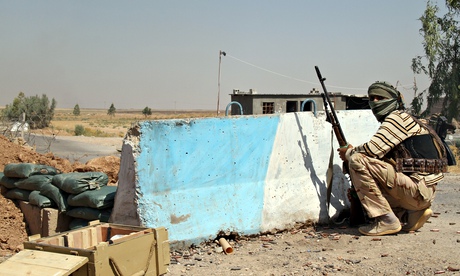
An Iraqi Turkmen fighter in a defensive position in Amerli.
Photo: Ali al-Bayati/AFP/Getty Images
Combat between ISIS and the Iraqi military near a major oil refinery. ISIS has attacked the facility multiple times, but the Iraqi military has successfully repulsed all attacks.

The Shia village of Amerli is under siege by ISIS. A Turkmen militia appears to be defending Amerli, but the villagers are lacking food and water. Observers fear a massacre if the terrorist group captures the town.

Rising sectarian violence in Iraq worsened this week. Sunni parliamentarians suspended negotiations to form a new government after Shia gunmen killed 73 Sunni worshippers at a mosque in Diyala province. The removal of divisive Shia Prime Minister Nouri al-Maliki has not been enough to reduce tensions.


Syria

ISIS has taken territory from the Syrian government. Giving in to public demand for retaliation, the Syrian government has launched airstrikes against ISIS in response. Unlike American airstrikes in Iraq, they seem to have mostly hit civilians. Failure to act meaningfully against ISIS may delegitimize the Syrian government – especially if the moderate U.S.-backed rebels of the Free Syrian Army succeed in fighting the terrorist group. The Syrian government ignored ISIS earlier this year, as the group initially targeted Free Syrian Army, who have fought the Syrian government since 2011.

A British member of ISIS beheaded American journalist James Foley this week. American special forces failed to rescue him and other hostages earlier this summer, finding that the hostages had been moved shortly prior to the raid.


The Syrian military has introduced improvised bar armor for its T-72 tanks – a low-tech solution to a high attrition rate. The bars and chains, set at a distance from the tanks’ armor, are meant to detonate incoming anti-tank rockets prematurely to prevent destruction of the vehicle. The improvisation suggests that Syrian government armories are running out of reactive armor – a more effective, but more expensive, technology that does the same thing with a directed explosion.

More than 191,000 people have been confirmed killed in the Syrian Civil War. Some estimates put the death toll at above 260,000.


An air strike hits a house in Gaza. Photo: Reuters.

Israel and Gaza

The exchange of rockets and airstrikes resumed again when peace talks collapsed on Wednesday. Both sides claimed victory when Israel withdrew ground troops from Gaza on August 5.

The barrage of airstrikes has had a severe effect on Gaza’s economy, destroying 360 factories. Thousands of acres of farmland have been ruined.

Hamas has executed 18 people it accuses of “collaborating with Israel” without trial. Along with three Hamas commanders, more than 2,000 others, mostly civilians, have been killed in Gaza; fewer than seventy Israelis, almost all soldiers, have been killed.


Afghanistan

The Taliban have launched a major offensive in southern Afghanistan’s Helmand province. Helmand has been the site of near-continuous fighting since 2006. Afghan police claim that the Taliban have been using night-vision goggles, suggesting a foreign supplier.

Reports indicate that the Taliban have been using drugs to make bombers – including children – suicidal.

The disputed presidential election is still being recounted.

The total number of casualties over the course of the thirteen-year war is unclear.


Libya
Militiamen ride on a T-55. Photo: Reuters.

Islamist fighters have seized the airport in Tripoli, Libya’s capital. Unknown planes struck Islamist positions last week. The diverse militia groups fighting in Libya have coalesced into roughly Islamist and nationalist coalitions, which are in conflict with each other. The Libyan government has failed to exert effective control.


India: Kashmir

Indian and Pakistani troops exchanged fire across the Line of Control early Saturday morning, killing four civilians. Both countries accuse the other of shooting first. An Indian border guard was killed in cross-border fire last month.

Hopes for improved relations were dashed last week when India’s new Prime Minister Narendra Modi cancelled high-level talks with Pakistan, after Pakistani representatives met with an Indian separatist group. Pakistani diplomats have talked with the group in the past. Modi earlier accused Pakistan of waging a proxy war in Indian Kashmir. The separatist insurgency in Kashmir has led to 93 deaths this year.

This year, other insurgencies in India have killed 476.


China: Xinjiang

China has executed eight people believed to be behind the 2013 bomb attack in Tiananmen Square. The attack is believed to have been the work of Uighur separatists. The Chinese government has launched a massive crackdown on ongoing Uighur unrest in Xinjiang.

Uighur representatives have disputed the government’s narrative on a recent supposed riot, claiming that police fired on a peaceful protest, and have killed others in “massacres”.

Saturday, August 16, 2014

This Week in War News: August 10-16, 2014

Iraq
Displaced Yazidis walk towards Syria. Photo: Reuters.

Iraq’s sectarian Prime Minister Nouri al-Maliki has stepped down. He will be replaced by Haider al-Abidi, who will hopefully form a more inclusive government.

The focus of the fighting remains in the Kurdish-populated areas of northern Iraq. The ever-brutal ISIS has massacred 80 Yazidis for refusing to convert to Islam, for a total of about 500. Some have been buried alive.

An American mission found the situation of the Yazidi refugees trapped on Mount Sinjar to be better than expected. The refugees are not in immediate need of evacuation. U.S. airstrikes and international humanitarian support continue. Canada and France are arming the Kurdish Peshmerga in their fight against ISIS; Britain has been conducting aerial surveillance of the terrorist group.


Ukraine and Russia
Ukrainian soldiers at a checkpoint near Donetsk. Photo: Reuters.

The large Russian humanitarian convoy has not yet entered Ukraine. Ukrainian officials will inspect the cargo before the convoy crosses the border, making it less likely that the aid will be used as cover for an invasion, as Ukrainian and western observers initially feared. BBC journalists inspected trucks from the convoy, finding many of them to be almost empty.

Ukraine claims to have engaged a Russian armored column within Ukraine. Images show a destroyed BMP-2 in painted like some of those used in the Russian Ground Forces. Russia denies the existence of any such convoy. If Russian soldiers have indeed been killed in Ukraine, that would be a repeat of a 1994 Russian convert offensive against Chechen separatists; in that event, efforts by the government to conceal soldiers' deaths lead to anti-war protests spearheaded by soldiers' mothers.

A separatist leader claims that Russia will deliver 150 armored vehicles, including 30 tanks, and 1,200 trained fighters to the Ukrainian separatists in the near future. The separatist leadership was recently reshuffled, possibly due to their inability to effectively hold territory. There will likely be no change in their effectiveness or actions despite the new leadership.

The Ukrainian military appears to be on the verge of capturing Horlivka, a large town near to the encircled separatist stronghold of Donetsk. So far, the fighting has killed 2000, wounded 5,000, and displaced 285,000.


Syria

The Syrian National Coalition, the nominal leadership of Syria's moderate rebels (the Free Syrian Army and other groups), has called for international intervention against ISIS in Syria. This request seems to have come at the request of U.S. representatives, according to Al Jazeera. If so, the call for intervention will probably be answered by U.S. air strikes against ISIS positions in Syria as well as in Iraq.

The situation in Syria is extremely complicated. While both Iran and the U.S. have supported Iraq against ISIS, they are backing opposing sides in the Syrian Civil War. Iran backs the Assad government, and the U.S. backs the Free Syrian Army. Also involved are ISIS, other Islamist groups like Jabhat Al-Nusra, and Kurdish People's Protection Units (YPG) in the north of the country.

Commentators on the war – still the bloodiest currently ongoing – are debating which side is winning, suggesting that the Syrian government’s long offensive has come to an end.


Afghanistan

The Taliban have kidnapped five Red Cross workers. On Friday, the Afghan military appears to have independently rescued three Indian engineers who the Taliban had previously captured, arresting one person in the process.

The results of Afghanistan's recent presidential election are still to be determined, though agreements between the candidates (Ashraf Ghani and Abdullah Abdullah) have reduced the chances of the government collapsing. The agreements were facilitated by U.S. Secretary of State John Kerry.


Kashmir

India’s new Prime Minister Narendra Modi accused Pakistan of waging a proxy war against India at a recent speech in Kashmir. A sporadic insurgency in the majority-Muslim region, also claimed by Pakistan, is ongoing. The Kashmir region is divided between India, Pakistan, and China. Modi's visit to Indian Kashmir is the first since the 1999 Kargil War.


Elsewhere in the world, fighting is ongoing in rather a lot of places.

Saturday, August 9, 2014

This Week in War News: August 3-9, 2014

Iraq

Peshmerga fighters on the front lines. Photo: Reuters.
The US has launched airstrikes on ISIS artillery with the intention of stopping the terrorist group’s advance on Erbil, currently controlled by Kurdish Peshmerga forces. The Peshmerga, formerly considered to be more capable than the Iraqi military, has retreated from ISIS multiple times in the last few weeks. ISIS appears to be attempting to carry out genocide against Iraq’s Yazidi minority population.

Yazidism is a unique, 4,000-year-old monotheistic religion. Iraq has about half a million Yazidis. ISIS, which considers them to be “devil-worshippers”, is holding hundreds of Yazidi women prisoner, and is accused of selling them as slaves. About 35-50,000 Yazidis who fled ISIS’ advance are trapped in the Sinjar mountains are being supplied food and water by the US and Turkey.

This past week, ISIS captured the poorly-built Mosul Dam, Iraq’s largest, which supplies water and electricity to millions of Iraqis. If ISIS destroys it – or even fails to maintain it – the rush of water will flood Mosul and parts of Baghdad, killing up to half a million people and leaving millions more without power.


Ukraine and Russia

Russia has banned Western food imports and is threatening to block international commercial access to its airspace. This suggests that Russia will be willing to cut off gas exports to the EU as winter approaches.

Russia and Ukraine are inching towards open war. International fears that Russia will invade eastern Ukraine are growing. In the absence of an open Russian invasion, it is almost certain that the Ukrainian military will succeed in retaking Donetsk and Luhansk, the two main bastions of the separatist movement. Donetsk appears to have been isolated from the rest of the separatist-held territory, and Luhansk will probably be surrounded soon. More than 1,500 people have died in the fighting so far.

There was a false alarm over Aeroflot flight 1127, which was briefly believed to have disappeared in the air near eastern Ukraine.


Israel and Gaza

Israel has withdrawn its ground troops from Gaza. Another ceasefire has collapsed, with Israeli airstrikes and Hamas rocket attacks resuming. Israel says the IDF accomplished its objective of destroying Hamas tunnels; Israel’s original objective was to stop Hamas’ rocket attacks.

More than 1,900 Gazans, mostly civilian, and fewer than 70 Israelis, almost all soldiers, have been killed since the fighting began a month ago. One Thai national, working in Israeli, was also killed.

An apparently accidental Israeli strike on Gaza’s main power plant has caused the humanitarian situation in Gaza to worsen considerably.


Afghanistan and Pakistan

Abdullah Abdullah and Ashraf Ghani, Afghanistan’s two presidential candidates, have agreed to a power-sharing deal regardless of who is determined to be the winner of the disputed election. The deal – which goes along with the ongoing recount – was brokered by US Secretary of State John Kerry, and will include the creation of a more powerful prime minister, and the creation of a “chief executive” position to be filled by the loser’s candidate.

The Taliban have taken ground in this year’s summer offensive. On the other side of the border, Pakistan claims to have killed 500 Taliban for the loss of 27 soldiers in a recent offensive in North Waziristan. 800,000 people have been displaced by the fighting.


Yemen

Al-Qaeda has kidnapped and executed fourteen Yemeni soldiers. The attack seems to be in retaliation for the combat deaths of 25 suspected fighters in south Yemen over the last week.

The Yemeni government has signed a ceasefire with minority Shia Houthi fighters in the north of the country. This will hopefully bring an end to one of Yemen’s three ongoing insurgencies.


Elswhere in the world, fighting is ongoing in Syria, Nigeria, Pakistan, Somalia, South Sudan, the Democratic Republic of the Congo, and India.