 |
| President Xi Jinping and Indian Prime Minister Narendra Modi. Photo: PTI |
The Evidence
It’s starting to appear that the Chinese government does not
have complete control of its military.
The People’s Liberation Army (or PLA) has of late developed
a tendency to provoke international incidents for no clear reason. On September
18, during Xi Jinping’s three-day presidential visit to India – one intended to
improve ties between the two countries – nearly a thousand Chinese soldiers
crossed into Indian-controlled Kashmir. India has placed 15 battalions – about
6,000 soldiers – on high alert. This one violation of the Line of Actual
Control (LAC) has threatened to demolish the agreements and good will that the
visit produced. It also risks driving India into a military pact with Japan –
something China has been seeking to avoid at all costs.
Then, on September 22, Chinese media reported that Xi told the
PLA’s chiefs of staff to “guarantee a smooth chain of command and make sure all
decisions from the central leadership are fully implemented.” A statement
released afterwards said that “all PLA forces should follow the instructions of
President Xi and update their operations to meet new goals and missions set by
the CMC.”
The word “continue” never came up. You don’t call for
something you already have. These are not the statements of a leader with
confidence in their military’s obedience – especially coming so soon after a
border crossing that risks destroying recent progress in Sino-Indian relations.
Probable Cause: Reforming the Military Regions
 |
| China's Military Regions. Full size here. Source: Wikimedia Commons |
There’s good reason for the PLA’s possible discontent: Japan’s
Yomiuri Shimbun reported this January that the PLA will eliminate two of its
seven “military regions,” cutting 300,000 mainly logistical and administrative
personnel (probably mostly from the PLA Ground Forces, China’s land army). Chinese
media later confirmed the reports. Each military region has its own independent
headquarters with control over the troops in its jurisdiction and its own
strategic focus. The new organization will focus on the coastal regions,
merging the four inland regions into two reserve areas. The objective will be
to better project force into the South China Sea (towards Vietnam and the Philippines)
from the Guangzhou Military Region, into the East China Sea (towards Taiwan and
Okinawa) from the Nanjing Military Region, and into the Yellow Sea (towards
Korea and Japan) from the Jinan Military Region. The Chengdu and Lanzhou
Military Regions (bordering India and Central Asia) will probably be merged, as
will the Beijing and Shenyang Military Regions (bordering Mongolia, Russia, and
North Korea). The change is to be implemented by 2022.
This means that in the next five years, a large number of
officers are going to be fighting for their jobs. A war with India might prove
the need to maintain large ground forces in Tibet, lending more resources and
prestige to the Chengdu Military Region. It’s possible that some officers –
either on their own initiative or on the orders of the military region’s
commander – may be deliberately provoking India with this end in mind.
That said, there are other possible causes. The Chinese military establishment is not without hawkish hardliners who'd like to see an expanding Chinese state. Such individuals could be perfectly capable of pushing for war whether it advances their own career or not.
Alternate Explanations
There are alternate explanations for the recently-erratic
behavior of the PLA. If the Chinese government is indeed in full
control of the PLA, it is either attempting to project strength for a hawkish
domestic audience while attempting to collaborate with its neighbors, or it is
attempting to create a diplomatic cover for genuine, deliberate aggression (see
also Russia). Both possibilities are improbable.
While it’s certainly the case that China would like to both
seem powerful and improve international relationships, arbitrary inconsistency
is far from the right way to do that. If anything, China's actions are inclined to damage its international reputation while projecting an unwillingness to commit
to serious military action.
It’s also unlikely that China is attempting to cover
aggression with diplomacy. China’s water-grabs in the South China Sea were both
successful and completely straightforward; there’s no reason to change a
doctrine that works. Tiny border violations and provocative flying also
accomplish absolutely nothing by themselves; they’re not worth mobilizing the
highest offices of a government to disguise. To do so would also be
inconsistent with China’s behavior prior to intervening in Korea in 1950 or
Vietnam in 1979 – both major actions that were preceded by no deliberate
high-level deception of any kind. What’s more, cutting troop numbers – as China
is planning – is rarely indicative of imminent preparations for war.
At the end of the day, an absence of firm civilian control
is the most probable explanation for strange Chinese military actions – especially
considering that Xi himself just called for closer political control of the PLA.
Dangerous Implications
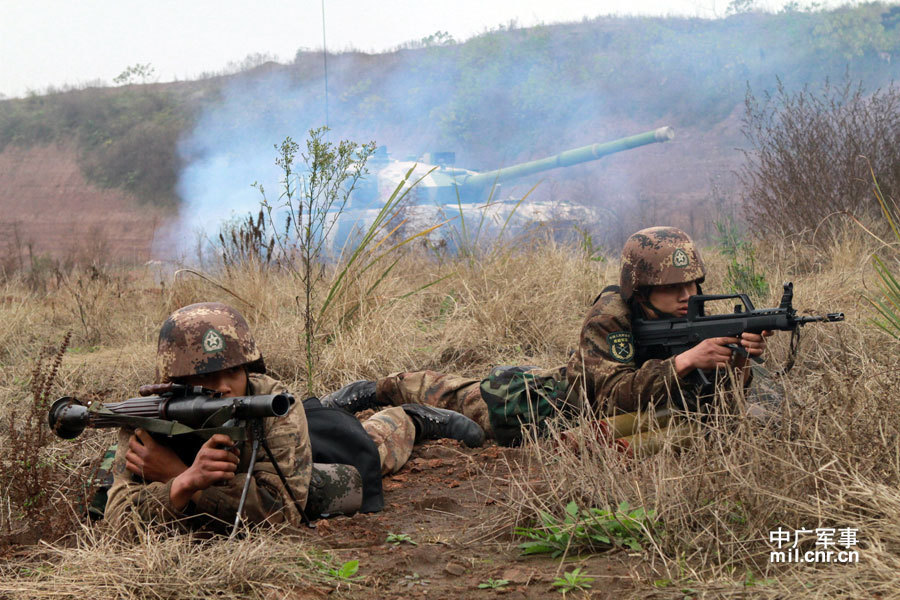 |
| Soldiers from the Chengdu Military Region train this January. Photo: mil.cnr.cn |
It may seem reassuring for China’s neighbors to hear that
the PLA will need years of military reforms before it becomes a serious threat
to a peer military. The PLA could otherwise risk being crippled by coordination
problems in a sufficiently large war – and may be at risk of insubordination in
conflicts of any size. It’s unlikely that China’s government will commit to a
war without knowing whether or not its orders will be followed.
The problem is that the Chinese government might have the decision to go to war made for them. In the short term, there are risks that a local commander will attempt to deliberately provoke a conflict for their own interests – either to further their own
career or to force their interpretation of China’s foreign policy objectives
on Beijing. We may be witnessing that on the borders of India right now.
Low-level military actions will continue be unpredictable and not necessarily
consistent with government policy.
A Brief Note on Imperial Japan
Imperial Japan suffered similar problems in the 1930s. By
that decade, civilian control of the military had completely disappeared, and Army
officers frequently acted independently, to the point of starting wars on their
own initiative. Officers acting without orders at Mukden in 1931 and at Lugou
Bridge in 1937 started two invasions of China.
Similar events are unlikely today. Rogue officers of the
modern PLA will probably not be able to obtain their government’s full
commitment to a war, but the risk does exist that they could attempt to. It
remains to be seen whether or not the PLA will fully comply with Xi Jinping's instructions –
but if they don’t, the results could be dire.
http://www.newindianexpress.com/columns/Aim-of-Chinas-Military-Reforms/2014/01/21/article2010589.ece

No comments:
Post a Comment