On paper, that looks like a lot. The reality is less
terrifying. I’ll discuss the armor ISIS has available.
The M1 Abrams: Great Tank – If Usable
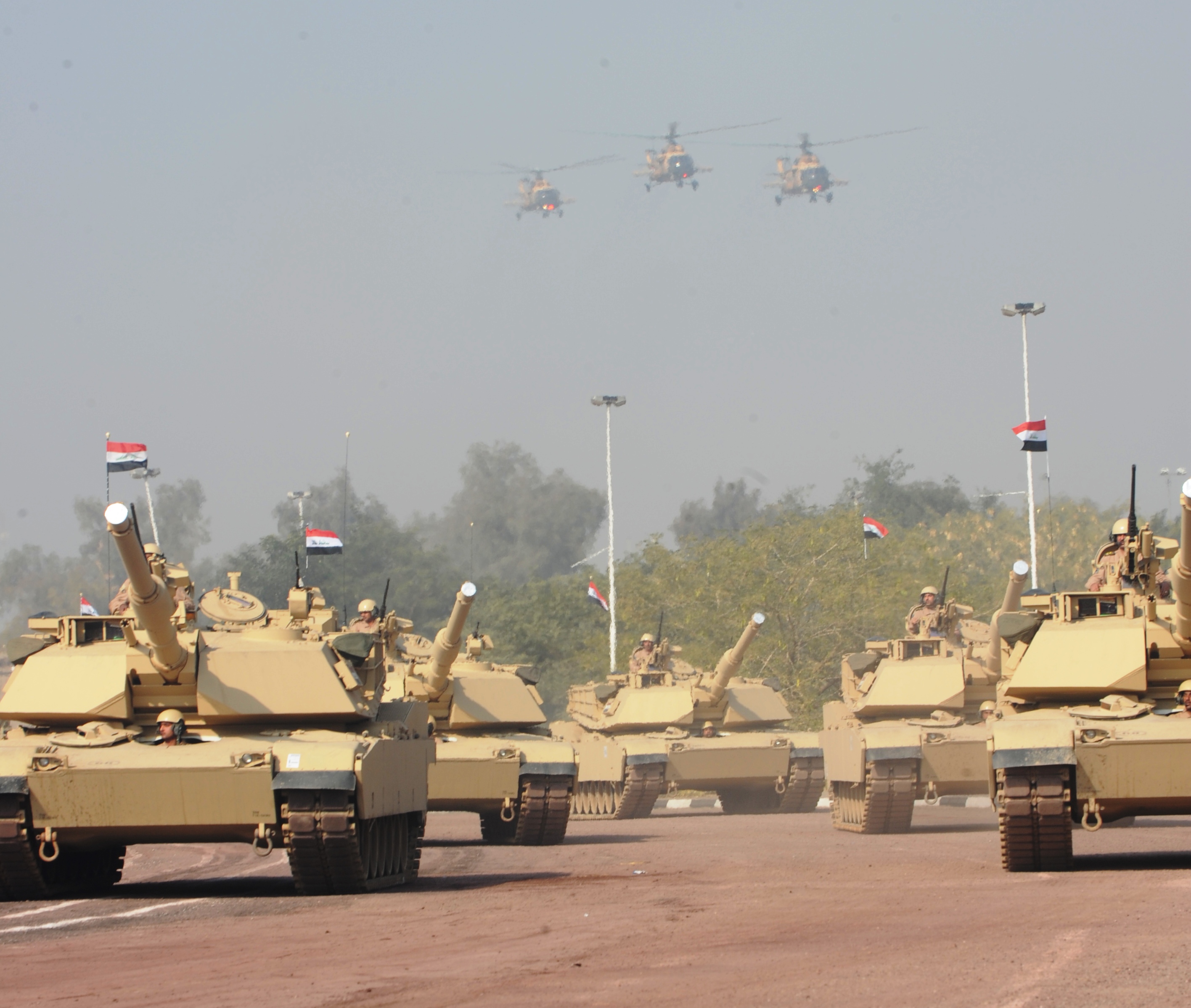 |
| Iraqi M1A1Ms on parade in 2011. Photo: Wikimedia Commons. |
The M1 Abrams* is the most effective weapon to have been
captured by ISIS so far. The Iraqi government decided to buy it because it had
been used against the Iraqi military twice – in 1991 and in 2003. In both
cases, it devastated the tanks that Iraq sent to oppose it, and proved almost
invulnerable to their fire. If you can’t beat ‘em, join ‘em. The tanks produced
for Iraq do not have the absurdly effective depleted uranium armor and
ammunition used in recent American models, but they do have improvements made
to the engine to make it more reliable in the deserts of Iraq. In addition to
the U.S. and Iraq, the Abrams is used by Saudi Arabia, Kuwait, Egypt, and
Australia.
The M1s captured from the Iraqi military were not taken
intact – the number of vehicles ISIS is believed to have captured corresponds
with the number of vehicles the Iraqi Army reported to have been badly damaged.
Some videos show ISIS destroying at least one of the tanks after it fell into
their hands, suggesting that at least some of them are completely unusable.
Those that aren’t will require significant maintenance to be used at all – not
to mention good, continuous logistical support just to keep the engine running.
ISIS would also need personnel trained to operate the tank. It is extremely
unlikely that ISIS will be able to use a single Abrams in combat.
*M1 indicates all versions of the tank, M1A1 a specific
improved version of the original, and M1A1M the Iraqi version of that version.
The T-72: Reliably Good Enough
| A Syrian T-72 in 2012. Photo: Reuters/George Ourfalian. |
The T-72 was meant to be a cheap, low-technology, but
effective tank that could be fielded in massive numbers by the Soviet Union. It
was widely exported.
When American tank formations demolished Iraqi armor in
1991, it was T-72s they were destroying. The M1 Abrams massively outclassed the
T-72s in Iraqi use at the time (though T-72s used by Iraq’s Republican Guard
did succeed in damaging a few M1s). T-72s have taken high losses in Syria, as
they did in Russian hands in Chechnya. South Sudanese T-72s were recently
manhandled by modern Chinese tanks in Sudanese service.
But the T-72 isn’t as awful as its record suggests. The
frontal armor can stop an RPG-7 – the most widely used anti-tank weapon in the
world. The 125mm main gun is enough to deal with most armored threats, given
the right ammunition (ammunition quality makes an enormous difference when
measuring the effectiveness of one tank against another). It’s also much easier
to use and maintain than more advanced tanks. Improved models and international
post-production upgrades make the better T-72s a good standard to measure other
tanks by.
ISIS will probably be able to operate the small number of
T-72s in their possession, making it much more of a threat than their M1s. While
the Peshmerga and other Kurdish militias don’t have many anti-tank weapons capable
of destroying a T-72 from the front, ISIS doesn’t have sufficient air defenses
to protect their tanks from air strikes, and will struggle to replace any tanks
and trained tank crews that they lose.
If the Iraqi Army is able to coordinate a combined arms offensive
against ISIS, the M1s still controlled by the Iraqi Army should make short work
of T-72s. This hinges on the ability of the Iraqi military to launch such an
offensive – Iraqi M1s will need the infantry in close support to protect them
from ATGMs, especially in urban areas. Iraqi forces have struggled to coordinate
combined arms in the past.
The T-55: Showing its Age
| A T-55 captured by ISIS in Syria. Photo: Reuters/Stringer. |
With their M1s unusable and their T-72s few and far between,
most of the working tanks in ISIS hands are T-55s. T-55s are widely used around
the world, despite being old, crude – and, critically, unable to stop an RPG-7
with their frontal armor. If T-72s performed poorly in 1991 and 2003, then
T-55s performed so badly that they may as well have not been used. Anything
worse than a T-55 (like the Type 63s used by China during the Sino-Vietnamese
war) is, in my view, absolutely terrible to the point of uselessness. That said,
the T-55 itself is good enough if the opposition doesn’t have anything better –
and having a T-55 is better than having no tank at all.
ISIS’ T-55s will not have a major impact unless they are used
well tactically. If ISIS concentrates their T-55s and uses them aggressively,
in concert with Humvee-borne infantry and concentrated artillery fire, they
will be extremely effective against the Iraqi military, the Peshmerga, Syrian
rebel groups, and the Syrian military. They will still be vulnerable to air
strikes. Fortunately, ISIS does not seem to have used combined arms in this way
so far. ISIS will probably continue to rely on light infantry, with tanks used
as fire support and captured artillery used mostly for harassing fire.
T-55s are no match for the Iraqi Army’s M1s. Once again,
effective use of combined arms by the Iraqi military will negate any advantage
ISIS receives from their own tanks.
It’s important to note that the Peshmerga also have several
T-55s – which may or may not be enough to balance out those used by ISIS.
Peshmerga T-55s will struggle against ISIS’ T-72s if they ever meet.
The T-62, or: Less Bad Still Isn’t Great
| A Peshmerga-operated T-62. Photo: Reuters/Yahya Ahmad. |
According to a German source, ISIS also has T-62s. Syrian
rebels of various stripes have captured T-62s from the Syrian government, as
documented by numerous photos. ISIS’ T-62s are not included in the numbers
above; they were probably mistaken for T-55s or T-72s by observers (T-62s have
the same five road wheels of the T-55, though they are differently spaced, and
a bore evacuator in the middle of the gun barrel like the T-72, though the gun
is of slightly smaller caliber).
The T-62 is an improvement on the T-55, with a much better
gun and thicker armor, and lies somewhere between the T-55 and the T-72 in
effectiveness. In the Iraqi context, consider T-62s to be a valuable, but not
decisive, augmentation to the T-55-dominated forces they accompany.
Humvees Aren’t Tanks
Humvees may be better protected than an unarmored vehicle, and
better armed than an unarmed vehicle, but that’s not saying much. At most, the
addition of Humvees to ISIS’ arsenal means that they have a machine gun
platform that’s resistant to small arms fire. Considering that they already had
technicals – pickup trucks with heavy machine guns or anti-aircraft guns on the
back – the presence of Humvees is almost meaningless.
A Note on Anti-aircraft Weapons
ISIS does have low-altitude surface-to-air missiles and
anti-aircraft guns. If concentrated, these weapons will be effective in driving
off helicopters, but they’re not enough to stop an airstrike from a higher altitude.
The anti-aircraft guns will most likely be limited to firing on ground targets –
a role that they aren’t terrible at, but one they’re unlikely to be decisive
in.
A Note on Artillery
ISIS has captured BM-21 Grad multiple rocket launchers –
also used in eastern Ukraine by both sides. This Soviet weapon is used to cover
a large area with an inaccurate volley of rockets, making it deadly for
civilians if used on populated areas, but practically useless for picking off
point targets. ISIS’ use of Grads will be limited by their inability to produce
more ammunition.
In Iraq, ISIS has also captured American M198 155mm
howitzers. While powerful and accurate, the M198 is difficult to learn to use;
it is unlikely that ISIS will be able to employ them to their full effectiveness.
That said, even inaccurate fire could be used for harassing fire or to shell
a city.
Overall: Could be Worse
At the end of the day, ISIS having tanks and other heavy
weapons is bad – but that doesn’t mean it’s catastrophic. They’re still
outgunned by the Iraqi Army, and they only overmatch the Peshmerga by a little.
Crucially, they have no effective response to aircraft operating at high
altitudes – and heavy weapons are difficult to hide. It’s possible that U.S.
airstrikes will deprive ISIS of their most powerful equipment, forcing them to
abandon heavy weapons for guerilla tactics.
It all depends on how the weapons are used. If ISIS learns
how to use them more effectively, and does use them in concert against Iraq, it’s
a very different story.
http://www.bild.de/politik/ausland/isis/isis-kaempfer-besser-bewaffnet-als-kurden-37324162.bild.html
Pollack, Kenneth
M. Arabs at War: Military Effectiveness,
1948-1991. Lincoln, NE: U of Nebraska, 2002. Kindle file.

No comments:
Post a Comment