Monday, September 29, 2014

Hong Kong: Will There Be a Crackdown?

The Situation

Protesters fill the streets on September 29.
Photo: Reuters/Tyrone Siu.
Enormous pro-democracy protests have wracked Hong Kong for days. Despite resorting to tear gas early Monday morning, the police have been ineffective in dispersing the protesters. The situation is escalating, and neither side is backing down. Worryingly, the LA Times has reported that the Hong Kong Garrison, the local military unit has been put on “high alert.”

The growing protest movement – called “Occupy Central with Love and Peace” in reference to Hong Kong’s business district, or the “Umbrella Revolution” for the umbrellas protesters have used to protect themselves from pepper spray – is calling for the right of the people of Hong Kong to nominate their own candidates in the 2017 Chief Executive election. On August 31 this year, the Chinese government announced that all candidates in that election will have to be approved by a state-appointed committee. That was a mistake. Beijing underestimated the pro-democracy activists’ depth of feeling. People in Hong Kong have repeatedly voiced their opposition to measures they see as oppressive, and Beijing has failed to take that sensitivity into sufficient account. Efforts to assimilate Hong Kong have only driven Hongkongers towards greater independence from the mainland – as of June this year, only a minority of the population of Hong Kong identify themselves as Chinese. The pro-democracy activists have stuck to their one demand, and it may be too late for Beijing to compromise. A crackdown may be on the way.


The Garrison

The People’s Liberation Army (PLA) Hong Kong Garrison – one of China’s highest-profile military units – is a 6,000-strong force with some of the PLA’s newest equipment. But it’s not armed to repel an invasion – its purpose is to put down an uprising in Hong Kong itself. The garrison’s ground force is largely light infantry with helicopters and wheeled personnel carriers – none of which seem to have the anti-tank weapons that would be necessary in a war – and it includes a naval unit with landing ships. The landing ships and helicopters may be intended to make it possible to move troops across Victoria Harbor (the channel between Hong Kong Island and the mainland) if the tunnels that run underneath it are blocked.

The idea that they’re intended to suppress an uprising isn’t speculation on my part. In 2012, units from the Hong Kong Garrison practiced operation against enemies imagined to be Cantonese-speaking in a simulated urban area (most of Hong Kong’s population speaks Cantonese, rather than Mandarin). They’ve also conducted armed naval exercises in Victoria Harbor – as opposed to the naval approaches to the city. It’s unambiguously clear where they’re expecting trouble to come from: the city itself. Because of this, the Hong Kong public doesn’t trust the garrison. Public sightings of PLA vehicles are frequently interpreted as attempts at intimidation.

The garrison has also had a recent change of leadership, suggesting that Beijing has asserted control in the face of possible widespread insubordination. If Beijing orders the garrison to put down the protests with force, they will probably follow their orders.

The Risks

No one wants another Tiananmen. A violent crackdown would seriously damage the Chinese government’s reputation both internally and internationally. Crushing hope for reform with bullets would also be guaranteed to worsen the unrest in Xinjiang, threatening China’s unity.

But the list of possible peaceful outcomes is getting shorter and shorter. The protesters aren’t going home – if anything, it seems that their numbers are growing. What was once a student protest is increasingly a representative cross-section of Hong Kong society. On the other side, Beijing can’t back down without legitimizing public involvement in politics – which it considers intolerable. With every day the protests continue, a violent crackdown becomes more likely.

A Note on Taiwan

It’s hard to predict what the exact consequences of such a crackdown would be. The “Umbrella Revolution” has had sympathy demonstrations in Taipei, the capital of Taiwan. A bloody crackdown risks pushing Taiwan closer to declaring independence – the one act sure to cause a Chinese invasion, which would likely lead to thousands of deaths. Like Hongkongers, the Taiwanese have increasingly affirmed an independent identity – but only a small minority of the Taiwanese population are in favor of formal independence at this point. Most support the status quo – de facto, but undeclared, independence. This does makes an invasion-triggering declaration unlikely – but violence in Hong Kong could still increase the pressure in that direction.


Wednesday, September 24, 2014

China May Not Control Its Military

President Xi Jinping and Indian Prime Minister Narendra Modi.
Photo: PTI

The Evidence

It’s starting to appear that the Chinese government does not have complete control of its military.

The People’s Liberation Army (or PLA) has of late developed a tendency to provoke international incidents for no clear reason. On September 18, during Xi Jinping’s three-day presidential visit to India – one intended to improve ties between the two countries – nearly a thousand Chinese soldiers crossed into Indian-controlled Kashmir. India has placed 15 battalions – about 6,000 soldiers – on high alert. This one violation of the Line of Actual Control (LAC) has threatened to demolish the agreements and good will that the visit produced. It also risks driving India into a military pact with Japan – something China has been seeking to avoid at all costs.

Then, on September 22, Chinese media reported that Xi told the PLA’s chiefs of staff to “guarantee a smooth chain of command and make sure all decisions from the central leadership are fully implemented.” A statement released afterwards said that “all PLA forces should follow the instructions of President Xi and update their operations to meet new goals and missions set by the CMC.”

The word “continue” never came up. You don’t call for something you already have. These are not the statements of a leader with confidence in their military’s obedience – especially coming so soon after a border crossing that risks destroying recent progress in Sino-Indian relations.

Probable Cause: Reforming the Military Regions

China's Military Regions. Full size here.
Source: Wikimedia Commons
There’s good reason for the PLA’s possible discontent: Japan’s Yomiuri Shimbun reported this January that the PLA will eliminate two of its seven “military regions,” cutting 300,000 mainly logistical and administrative personnel (probably mostly from the PLA Ground Forces, China’s land army). Chinese media later confirmed the reports. Each military region has its own independent headquarters with control over the troops in its jurisdiction and its own strategic focus. The new organization will focus on the coastal regions, merging the four inland regions into two reserve areas. The objective will be to better project force into the South China Sea (towards Vietnam and the Philippines) from the Guangzhou Military Region, into the East China Sea (towards Taiwan and Okinawa) from the Nanjing Military Region, and into the Yellow Sea (towards Korea and Japan) from the Jinan Military Region. The Chengdu and Lanzhou Military Regions (bordering India and Central Asia) will probably be merged, as will the Beijing and Shenyang Military Regions (bordering Mongolia, Russia, and North Korea). The change is to be implemented by 2022.

This means that in the next five years, a large number of officers are going to be fighting for their jobs. A war with India might prove the need to maintain large ground forces in Tibet, lending more resources and prestige to the Chengdu Military Region. It’s possible that some officers – either on their own initiative or on the orders of the military region’s commander – may be deliberately provoking India with this end in mind.

That said, there are other possible causes. The Chinese military establishment is not without hawkish hardliners who'd like to see an expanding Chinese state. Such individuals could be perfectly capable of pushing for war whether it advances their own career or not.

Alternate Explanations

There are alternate explanations for the recently-erratic behavior of the PLA. If the Chinese government is indeed in full control of the PLA, it is either attempting to project strength for a hawkish domestic audience while attempting to collaborate with its neighbors, or it is attempting to create a diplomatic cover for genuine, deliberate aggression (see also Russia). Both possibilities are improbable.

While it’s certainly the case that China would like to both seem powerful and improve international relationships, arbitrary inconsistency is far from the right way to do that. If anything, China's actions are inclined to damage its international reputation while projecting an unwillingness to commit to serious military action.

It’s also unlikely that China is attempting to cover aggression with diplomacy. China’s water-grabs in the South China Sea were both successful and completely straightforward; there’s no reason to change a doctrine that works. Tiny border violations and provocative flying also accomplish absolutely nothing by themselves; they’re not worth mobilizing the highest offices of a government to disguise. To do so would also be inconsistent with China’s behavior prior to intervening in Korea in 1950 or Vietnam in 1979 – both major actions that were preceded by no deliberate high-level deception of any kind. What’s more, cutting troop numbers – as China is planning – is rarely indicative of imminent preparations for war.

At the end of the day, an absence of firm civilian control is the most probable explanation for strange Chinese military actions – especially considering that Xi himself just called for closer political control of the PLA.

Dangerous Implications

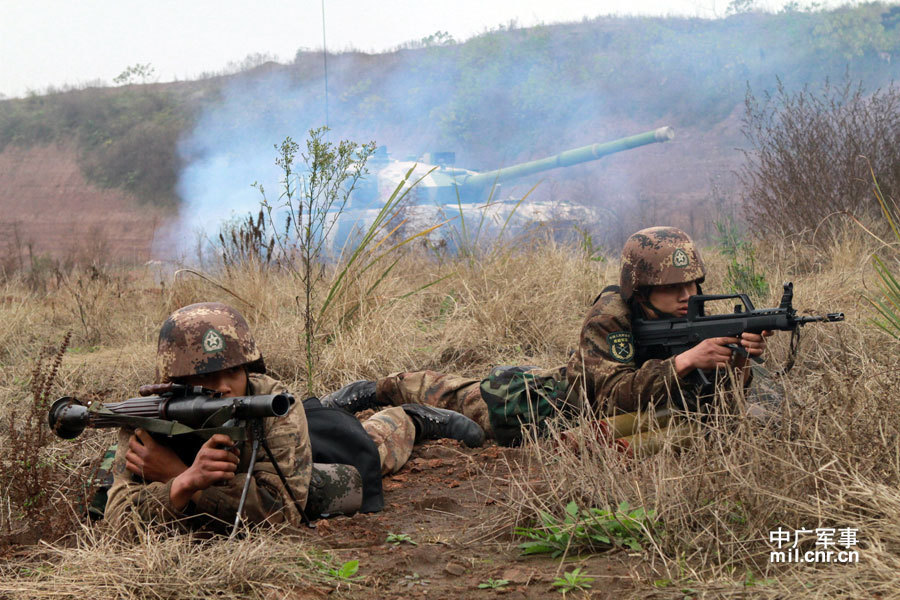
Soldiers from the Chengdu Military Region train this January.
Photo: mil.cnr.cn
It may seem reassuring for China’s neighbors to hear that the PLA will need years of military reforms before it becomes a serious threat to a peer military. The PLA could otherwise risk being crippled by coordination problems in a sufficiently large war – and may be at risk of insubordination in conflicts of any size. It’s unlikely that China’s government will commit to a war without knowing whether or not its orders will be followed.

The problem is that the Chinese government might have the decision to go to war made for them. In the short term, there are risks that a local commander will attempt to deliberately provoke a conflict for their own interests – either to further their own career or to force their interpretation of China’s foreign policy objectives on Beijing. We may be witnessing that on the borders of India right now. Low-level military actions will continue be unpredictable and not necessarily consistent with government policy.

A Brief Note on Imperial Japan

Imperial Japan suffered similar problems in the 1930s. By that decade, civilian control of the military had completely disappeared, and Army officers frequently acted independently, to the point of starting wars on their own initiative. Officers acting without orders at Mukden in 1931 and at Lugou Bridge in 1937 started two invasions of China.

Similar events are unlikely today. Rogue officers of the modern PLA will probably not be able to obtain their government’s full commitment to a war, but the risk does exist that they could attempt to. It remains to be seen whether or not the PLA will fully comply with Xi Jinping's instructions – but if they don’t, the results could be dire.

Tuesday, September 23, 2014

Iran Accepts U.S. Action

Early this morning, planes from the U.S., Saudi Arabia, the UAE, Jordan, Bahrain, and Qatar attacked ISIS targets in Syria, including training bases and command and control infrastructure. The strikes are confirmed to have caused heavy casualties. The Syrian government was informed beforehand and did not interfere.

Iran: Constructive Criticism?

Iran appears to have given backhanded support for the U.S.-led intervention. In an interview last week, Iran’s President Rouhani catered to a strongly anti-American domestic audience by criticizing the military action – but in a way that supported the principle behind the action.

Let me emphasize that: the President of Iran supports an American military intervention in the Middle East. This doesn’t happen often.

If anything, Rouhani criticized the developing for not going far enough, accusing Americans of being “afraid of their soldiers being killed in the fight against terrorism” and calling the coalition “ridiculous” for including countries suspected of financing ISIS – but he didn’t oppose the airstrikes themselves. He did question their effectiveness (“if we want to combat terrorism, we have to go to the roots of the problem”), but there’s a good reason for that: the only time Iran has suffered airstrikes was during their war against Iraq, during which the Iraqi air force accomplished exceedingly little.

It is time for a fundamental reappraisal of Iran’s foreign policy interests. The assumption that Iran will always oppose the U.S. has been decisively proven wrong. The two countries do share interests, and may be able to collaborate in future. The nuclear negotiations haven’t been written off yet; there’s good reason to hope that an agreement will be reached eventually.

Rouhani is a moderate who is at times obligated to cater to domestic conservatives. This can be overstated – Rouhani’s not a Perfect European Liberal Democrat – but for Iran he’s about as close as it gets. He wants Iran to remain a theocratic Islamic state – but he wants it to be a modern and functioning theocratic Islamic state. That means one that will have to be able to live with its neighbors – including Israel.

Unfortunately, the expansion of the strikes into Syria may cost Iran's support. Rouhani also said that strikes should not take place without the permission of the country they occur in – and no permission was asked for the strikes earlier today. Russia has similar objections.

“We will not allow Baghdad to be occupied by the terrorists.”

Rouhani also heavily criticized ISIS, saying “they have nothing to do with Islam… It doesn’t make any difference from our viewpoint if the person is Muslim, Jewish, Christian or is the follower of any other religion… From the viewpoint of the Islamic tenets and culture, killing an innocent people equals the killing of the whole humanity. And therefore, the killing and beheading of innocent people in fact is a matter of shame for them [ISIS] and it's a matter of concern and sorrow for all the human and all the mankind.” He also suggested that Iran would be willing to send troops against ISIS.


Saturday, September 13, 2014

The Obama Doctrine and ISIS

No Change in Strategy

Two days ago, on the thirteenth anniversary of September 11, President Obama gave a speech that should have taken no one by surprise. The plan he described is the implementation of the same foreign policy the U.S. has had since 2009 – the use of airstrikes and allies to deal with designated threats while minimizing the involvement of American ground troops. It’s the same strategy used in Libya, Somalia, and Yemen. It’s the same strategy that led to the 2011 killing of Osama bin Laden.

As explained in this speech, the plan is straightforward: strike the horrific terrorist group ISIS from the air, both in Iraq and in Syria; promote an inclusive government for Iraq; bring in an organized coalition of allies, with a focus on Arab states; and support the moderate Syrian rebels of the Free Syrian Army (FSA) against Assad.

There are flaws with this plan – especially regarding the expansion of airstrikes into Syria. The U.S. would need to communicate with the FSA to ensure that targets are correctly identified – otherwise there would be a risk of striking the FSA by accident. But communicating with the FSA about targets would make it possible for the FSA to deliberately misidentify Syrian government forces as ISIS. A U.S. airstrike against Assad could provoke a response that the U.S. would deliberately respond too, drawing the U.S. into the war and giving the FSA the air support they’ve wanted since 2011.

The Mahdi Army, a Shia militia that fought against U.S. troops
during the Iraq War, fires on ISIS. Photo: Reuters/Ahmed Jadallah
Of course, a more limited response would be politically difficult given the hawkish nature of American political discourse. The U.S. is the only country that would be realistically capable of invading almost anywhere on the planet, and the use of that capability can be excruciatingly tempting.

In this case, putting ground troops on the front lines is not a reasonable option. ISIS would love to be seen as a group actively fighting against the U.S. Being able to directly attack American troops would probably assist ISIS’ recruitment efforts and increase, not decrease, their legitimacy in the region.

Neither Islamic nor a State

Obama described ISIS – which prefers to call itself the “Islamic State” – as “neither Islamic, nor a state.” Groups and even countries calling themselves things they aren’t isn’t a new practice. Voltaire once described the Holy Roman Empire as “neither holy, nor Roman, nor an empire.” These days, I can’t imagine anyone believing that the Democratic People’s Republic of Korea is democratic, a republic, belongs to its people, or is all of Korea simply because it claims to be.

With the American public leaning towards war, the difference between ISIS and Islam is important to point out. No group of people since al-Qaeda has been more widely denounced by Muslim scholars and communities around the world. ISIS is so far from the Islamic mainstream that conspiracy theories have emerged suggesting that it’s a proxy created by the U.S. to attack Muslims.

Regard the claim to statehood: it's no more a state than the average drug cartel


Tuesday, September 9, 2014

Examining an Invasion

"Cease"fire

So far, the ceasefire declared on Friday, September 5 has held – sort of. Since fire "ceased," Ukrainian government positions in Mariupol and at Donetsk Airport have been repeatedly shelled. Both locations are strategically important – the airport is the Ukrainian government's last foothold in the focal city of the pro-Russian separatist movement, and Mariupol was one of the main targets of the overt Russian invasion.

A ceasefire that mostly holds is a bit like a boat that mostly floats. It's not enough.
A Ukrainian tank on the outskirts of Mariupol after the ceasefire.
Photo: Reuters/Vasily Fedosenko

Eyewitness accounts suggest that the separatists fired first, and the Ukrainian military shot back. Separatist representatives claim the opposite – which is improbable. The most likely explanation is that the separatists simply continued their offensive after they failed to accomplish their objectives in the last hours before the ceasefire came into force (those last hours were characterized by direct tank attacks on Mariupol and fighting around the Donetsk Airport). The violations suggest either complete anarchy in separatist-controlled areas, or that the separatists and their backers were negotiating in bad faith.

The Invasion's Objectives

The objectives of the Russian invasion were probably threefold.

  1. The main objective was almost certainly to break the sieges of Donetsk and Luhansk, the last separatist strongholds, both of which had been encircled by the Ukrainian military. The fall of the last separatist-held cities would probably have led to the end of the fighting and a major symbolic defeat for Russia.
  2. The encirclement of Ukrainian forces that were overextended between Donetsk and the Russian border was probably a secondary objective. In addition to reducing the strength of the Ukrainian military, a large number of prisoners would have made a useful bargaining chip.
  3. Finally, and surprisingly, Russian troops attempted to seize Mariupol. The intention was probably to divert Ukrainian reserves and threaten to open a land connection with Crimea. Seizure of Mariupol would have also aided the claims of the separatists to represent the whole region, as they currently only control two cities of any size.


The first objective succeeded. Donetsk Airport is the last Ukrainian government foothold in either city. The Ukrainian military was driven out of Luhansk completely. The Russian motorized infantry battalion probably took part in that fighting. It is shown in the video on the road between Luhansk and the Russian border, supported by a tank company and at least two 2S1 "Gvozdika" self-propelled howitzers.

The Russian incursion also succeeded in surrounding a number of Ukrainian troops south of Donetsk, mainly from the less-capable "volunteer battalions."

Despite repeated armored attacks supported by heavy artillery fire, Ukrainian troops still hold Mariupol. Historically speaking, frontal attacks have never been the most effective tactic for dealing with a determined defender in an urban area – as the Israelis learned in Gaza, the Ukrainians learned in Donetsk and Luhansk, and as the Russians should have learned in Chechnya. In all these cases, the attacker resorted to massed artillery fire as a way of dealing with their opponents, leading to large numbers of civilian casualties.

The recent bombardment of Mariupol suggests that the Russian forces in that area may be adopting the same methods.

The "Volunteers"

The Russian government – possibly forced into the open by growing casualties – now acknowledges that there are Russian soldiers in Ukraine, but characterizes them as volunteers. If the soldiers are indeed volunteers, then they're volunteering in whole units, and taking their equipment with them, with the apparent permission of Russian border authorities. One unit has even been decorated by Putin himself – presumably either for deserting and dying in a foreign country, or perhaps for getting lost, as Putin originally described the Russian soldiers captured by the Ukrainian military.

The units in Ukraine include elements of the 98th and 76th Airborne Divisions, and probably part of the 20th Guards Tank Brigade (the only unit known to operate the T-72B3, which has been seen in Ukraine), assisted by artillery that shuffles back and forth across the border as the situation demands.

The official death toll is now above 3,000. At least five have died since the ceasefire took hold. More than a million people have been displaced.

Sunday, September 7, 2014

Gaza 2014: A War in Review

Gaza, September 3, 2014. Photo: Reuters/Suhaib Salem
Between July 8 and August 27 this year, Israel and Hamas fought a war that left Gaza in ruins. Both sides have claimed victory. Israel did not succeed in its objective of stopping rocket attacks from Gaza, which continued after Israeli ground troops withdrew. While Israel eventually changed its objective to the destruction of tunnels, it’s not clear that even a majority of those were actually destroyed. Hamas has not achieved its own claimed objective of breaking the Israeli blockade of Gaza. This is a war that no one won.

The current death toll is 2,104 Palestinians, 66 Israeli soldiers, six Israeli civilians, and one Thai civilian (who was working in Israel). The U.N. says 1,462 of the Palestinian deaths were civilians (about 69%), but that figure is disputed.

Other consequences are less measureable. The war led directly to anti-Semitic protests in European capitals, including Berlin, and chants of “death to the Arabs” in Israel itself. Few expect that this war will be the last.

Tactics and War Crimes

Both sides accused each other of war crimes. Hamas has never disguised its attempts to directly attack Israeli civilians, and is widely identified as a terrorist organization. This does not excuse any war crimes from the Israeli side – which are difficult to prove, due to Israel’s prohibition of both the Human Rights Watch and Amnesty International in Gaza.

As has become expected, Hamas launched rockets into Israel, accomplishing little, and Israel attacked Hamas with air strikes into Gaza. On July 17th, when it became clear that the airstrikes failed to deter Hamas rocket fire, Israel sent in ground troops.

Most of the casualties on both sides occurred during the ground invasion.

On the ground, Hamas appears to have copied the tactics that Hezbollah used against Israel in 2006, primarily attacking Israeli troops with anti-tank guided missiles (ATGMs) or ambushing them with shorter-range anti-tank weapons like the RPG-7. The Israeli response was usually to bombard the firing position – and everything near it – with artillery fire. In some cases, exposed Israeli troops retreated into their Namer armored personnel carriers, which are proof against fragments from 155mm shells, allowing artillery to fire extremely near to them. 155mm artillery is not the most precise weapon in the Israeli arsenal.

Analysis

The ground invasion accomplished nothing. Once it began, extreme casualty-aversion on the Israeli side led to high civilian casualties, unnecessary destruction of Gaza’s infrastructure, and the failure to accomplish its original objectives. Hamas’ deliberate efforts to cause civilian casualties contributed to Palestinian civilian deaths and was the sole cause of Israeli civilian deaths.

Saturday, September 6, 2014

A Ceasefire in Doubt

A man rides past a Ukrainian BTR-3 or BTR-4 in Mariupol.
Photo: Reuters/Vasily Fedosenko
The Ukrainian government and Pro-Russian separatists both accuse each other of breaking a new ceasefire. Despite ambiguous announcements over the last few days, a ceasefire the Ukrainian government and pro-Russian separatists agreed to in Minsk yesterday has mostly held. A lasting peace deal was hoped to be just around the corner – but that won’t happen if the ceasefire collapses. So far, at least 2,600 people have been killed in the fighting, not including the 298 passengers and crew of Malaysia Airlines flight MH17. Over a million people have been displaced.

A prisoner exchange was planned for later today.

The Situation on the Ground

The Ukrainian military sabotaged the airstrip of Luhansk Airpot before separatist forces – including Russian troops, according to Ukrainian representatives – recaptured it. Dontesk Airport was still contested when the ceasefire took effect; it’s unclear who controls it. Both airports were focal points of the recent fighting. The separatists themselves probably do not have the resources to repair the airstrip in Luhansk – and without any functioning aircraft of their own, they have little reason to.

Mariupol remains in Ukrainian hands, despite a direct armored attack on it in the hours before the ceasefire. The attack was supported by heavy artillery fire, including multiple rocket launchers. Shortly before the attack, the Russian ambassador to the OSCE predicted that pro-Russian separatists would “liberate” the city, noting that the civilian population of the region “are ethnic Russians, though they have Ukrainian passports.”

It’s unlikely that the offensive towards Mariupol would have actually succeeded in creating a land route to Crimea. The offensive was probably either an attempt to give the separatists access to the sea and expand the territory under their control, or a feint to draw Ukrainian forces away from Donetsk and Luhansk.

The Ukrainian military was on the verge of recapturing both Donetsk and Luhansk when what appears to be an overt intervention by the Russian military swept into the country. Evidence of this is now overwhelming. Ukraine has captured Russian soldiers. Others have been killed. One Russian unit has even been decorated for some unknown reason. Photographs – including satellite photographs – abound.

A T-72B3 claimed to have been captured by Ukrainian forces
near Ilovaisk on August 28.

A Note on Tanks

Ukrainian representatives describe “Russian tank battalions” as leading the recent separatist offensives. The existence of concentrated armored units (a full-strength Russian armored battalion has 30 tanks) is unprecedented in the conflict.

In the first few months of the fighting, tanks in separatist hands were few and far between, generally being seen at most three at a time. The separatists even used World War 2-era tanks from war monuments to supplement their sparse arsenal. In recent months the number of tanks being used by the separatists has swelled to hundreds – far more than have been captured from the Ukrainian military. Either the tanks are from Russia, or the separatists suddenly developed the capability to produce them to modern Russian standards extremely rapidly.

Observers have identified the T-72B3 in photos of tanks recently captured by the Ukrainian military. The Russian military began acquiring T-72B3s, one of the newest Russian models of T-72, last year. The T-72 is a Soviet-designed tank that is still in widespread use. One photographs shows a T-72B3 with the white stripes the Ukrainian military has used to indicate not being separatist – suggesting a possible attempted “ruse of war” to sneak past Ukrainian positions. Variants of the T-72B3 were also used in a recent “tank biathlon”.

Wednesday, September 3, 2014

Ukraine Ceasefire?

UPDATE: After a flurry of contradictory information, the Ukrainian government has confirmed that only the conditions for a ceasefire were agreed to, not a ceasefire itself. Given the Russian government's insistence that it is in no way involved in the conflict in eastern Ukraine, it's unclear what actual measures Russia will consider itself able to agree to.

Ukraine's President Petro Poroshenko said today that he and Russia's Vladimir Putin agreed on a "permanent ceasefire" in eastern Ukraine by telephone. A Russian government spokesman says that "Russia cannot physically agree on a cease-fire, as it is not a side in the conflict." The exact content of the conversation between the two leaders is unknown, but it there seems to have been a miscommunication somewhere. So far, the fighting has not stopped.

Photo: Reuters/Maxim Shemetov
These announcements come just as the fighting in the region was escalating, with the sudden overt intervention of the Russian military. Russian soldiers have been killed and captured, and T-72 models used only by the Russian military have been sighted inside Ukraine. The EU was about to announce a new round of sanctions against Russia, and Barack Obama is currently visiting Estonia, which borders Russia, in a show of solidarity with NATO's easternmost members. What's more, Russian representatives announced yesterday that NATO would continue to top their list of national threats, and the President of the European Council reported that Putin told him he could "take Kyiv in two weeks" if he wanted to.

The recent escalations make the agreement  if indeed there is an agreement  completely unexpected. It follows a recent open-ended ceasefire in Gaza, which led to both Israel and Hamas claiming victory (again), and which is unlikely to resolve that conflict.

It's too early for optimism. Contradictory statements have been made before last week, Putin publicly called on the separatists to allow a humanitarian corridor for trapped Ukrainian troops. When a column attempted to withdraw through the corridor, separatists fired on it, killing about a hundred Ukrainian servicemembers. This may be another case in which the actions of the parties to the conflict do not live up to their words.

Finally, a representative of the separatists has now said that "there will be no cease-fire” while Ukrainian government troops are in separatist-claimed territory. It is extremely unlikely that this one telephone conversation will amount to anything in the long run.

Tuesday, September 2, 2014

Everyone's Doing It: War Crimes in Ukraine

“Violations of the laws of war by one side to the conflict do not justify violations by the other side.” – Human Rights Watch

Shelling Civilians

Amnesty International and the Human Rights Watch have implicated both Ukrainian government forces and pro-Russian separatist forces in the bombing and shelling of civilian areas. Belligerents are obligated by international law to distinguish between military targets and civilians, and not to engage in acts that cause civilian casualties disproportionate to the military advantage gained by the action. For instance, issuing an order to fire on anything that moves would be clearly criminal (not distinguishing between combatants and civilians), as would the fire-bombing of a hospital to suppress a single sniper (civilian damage being clearly excessive to the military advantage from threatening one enemy).

Despite denials from both sides, there is little evidence that either the Ukrainian military or the separatists have taken any practical actions to protect civilians.

The Grad

A Russian Grad during a recent exercise.
Photo: Andrey Kronberg/AFP/Getty Images
The BM-21 Grad is a Soviet multiple rocket launcher (MRL) that is widely used around the world. Based on the World War 2-era BM-14 “Katyusha”, the purpose of BM-21 is to bombard large, prepared enemy defensive positions prior to a ground assault. It is extraordinarily indiscriminate, being incapable of targeting an area smaller than about 200x300 meters. When fired, a Grad will cover that area with 40 122mm rockets, firing one every half-second. Unlike more-modern MRLs, some of which can fire precise, GPS-guided rockets, there is no way to aim a Grad at specific targets.

Ukrainian troops reload a Grad.
Photo: Aleksey Chernyshev/AFP/Getty Images
The use of this weapon in particular has been heavily criticized by human rights groups – with good reason. If used on a populated area, civilian casualties are all but guaranteed. The use of Grads in this manner suggests a lack of effort to distinguish between civilian and military targets.

The Ukrainian military, the separatists, and the Russian military are all known to operate the BM-21. BM-21s have also been used to bombard civilian areas during the Libyan and Syrian Civil Wars, by the Qaddafi and Assad governments. ISIS has captured Grads from the Syrian military.

Abductions, Torture, Executions, and Threats

The human rights organizations also document the abduction, torture, and execution of civilians both by the separatists and by “volunteer battalions” fighting for the Ukrainian government.  The separatists have attacked journalists, religious minorities, and supporters of the Ukrainian government; government militias appear to have limited their attacks to those they believe to be affiliated with the separatists. This does not excuse the actions of either side.

So far, there seems to be little evidence of the regular Ukrainian military committing these crimes. It’s possible that even Ukrainian shelling of separatist-held cities is also primarily the work of poorly-disciplined volunteer battalions, but even if this is the case, the Ukrainian military bears responsibility for allowing these violations to continue. No hands are clean here.

A Note on History

Exactly 75 years ago yesterday, Germany invaded Poland. The first action of the war began at 4:40 AM with the dive-bombing of the town of WieluĊ„. Repeated waves of bombers destroyed 70% of the town and killed between 1,200 and 1,300 people – the equivalent of half the fighting in east Ukraine in the span of hours. There was no military presence in the town whatsoever.


Monday, September 1, 2014

Germany Arms the Kurds: No Silver Bullet

Guns Not Soldiers

Today, the German government announced that it will send a shipment of arms to the Peshmerga, the fighting forces of Iraq’s Kurdish minority, marking the effective end of a long-standing ban on the shipment of arms to combat zones. That ban has become increasingly symbolic in recent years, as “exceptions” have unfortunately started to become the norm. Germany is one of the world’s largest arms exporters – and its buyers include countries with well-documented human rights abuses.

A majority of Germans oppose the decision to send weapons.

What’s on the List?

Peshmerga Humvee on the Mosul Dam, August 21.
Photo:Reuters/Youssef Boudlal
The shipment includes 16,000 rifles, 10,000 grenades, 500 MILAN anti-tank guided missiles (ATGMs) with 30 launchers, 40 machine guns, and 5 Dingo armored vehicles (equivalent to lightly-armored Humvees). All are to be delivered over the course of this month.


Some of these weapons are actively counterproductive. The rifles are an equal mix of new G36 assault rifles, which fire 5.56x45mm bullets, and Cold-War-era G3s, which fire 7.62x51mm bullets. This will dramatically increase the logistical burden on the Peshmerga, which has so far only used weapons that fire the widespread 7.62x39mm and 7.62x54mm bullets. Absent a substantial, steady supply of the correct bullets, forward units will be at risk of running out of ammunition during long engagements – even if resupply is prompt, they will risk being supplied the wrong bullets. All four bullets are unusable in guns designed for any of the others.

Not all of the weapons are useless. The MILAN missiles will be effective in dealing with ISIS-captured tanks – though ISIS’ tanks are unlikely to be decisive anyway. There are risks that the ATGMs could be used against Turkey or Iraq. MILANs captured from Syrian arsenals have already proliferated in the region, and increasing the volume won’t exactly resolve that problem.

The Dingoes, on the other hand, don’t really threaten anyone. They do provide the Peshmerga with mobility that is protected against small arms fire (like the U.S.-supplied Humvees the Kurds already have) – but there are only five of them. That’s not even enough to transport fifty armed soldiers. The Dingoes will also be vulnerable to RPG-7s, the most widely used antitank weapon in the region, and the improvised explosive devices (IEDs) that ISIS has begun to use.

Why the Kurds?

Peshmerga fighters fire a US-made M40 recoilless rifle towards
 ISIS positions. The 105mm shell fired by the weapon probably
cannot penetrate the frontal armor of the handful of T-72s in ISIS
use, but should easily defeat the T-55 used in larger numbers.
Photo: JM Lopez/EPA
The decision to support the Kurds specifically plays into a recent western tendency to treat the Kurds as a silver bullet to Iraq’s problems. The Kurds, so the thinking goes, succeeding in resisting ISIS where the Iraqi military failed, and haven’t been implicated in sectarian violence – so why not make them the proxy of choice?


It’s certainly true that the Peshmerga are an inclusive organization. The problem is twofold: they haven’t actually been more effective than the Iraqi military, and support to them puts Iraq’s fragile unity at risk.

Observers have been inclined to forget that when ISIS turned against the Kurds, the Kurds retreated too. Just like the Iraqi military, they struggled to counter ISIS’ infiltration tactics, and blamed their losses on insufficient weapons. Like the Iraqi military, they only succeeded in stopping ISIS’ advance when supported by U.S. airstrikes – and they’ve only succeeded in advancing while working together with the Iraqi government.

The other issue is that a well-armed Peshmerga could be used to support a bid for Kurdish independence. That could be disastrous – Iraq is not without sectarian problems, and an attempt to create a Kurdish state by violent means would do absolutely nothing to improve the situation. I can’t emphasize too much that the recent successes against ISIS have been the product of cooperation between the Kurds and the Iraqi government. Iraq has a chance to come out of this war as a more stable, more inclusive state – a chance that could easily be dashed by either side. Supporting one group of Iraqis at the expense of others is not and has never been the solution – it didn’t work in 2004, and it won’t work now.

Saturday, August 30, 2014

Russia's Airborne: the VDV

Ukraine recently captured ten soldiers belonging to Russia’s airborne forces – the VDV (Vozdushno-desantnye voyska). The Russian government claims that the ten soldiers, who belong to a unit normally stationed in Kostroma, hundreds of kilometers northeast of Moscow, got lost while patrolling the Russian-Ukrainian border. This is extremely improbable – it’s the equivalent of the U.S. government claiming that a squad of Army Rangers stationed in Chicago got lost in Mexico while performing their regular duties as border patrol.

Russia has a large, well-armed, militarized Border Guard, which is a branch of the FSB (formerly the KGB). The VDV, in contrast, are a branch of the Russian military. Russia’s different government agencies are not known for working together – which led to disaster in the First Chechen War, when the Russian military failed to effectively support soldiers belonging to the Internal Troops (VV), who are a branch of the Ministry of Internal Affairs.

So, if not border guards, what exactly are the VDV for?

The Spearhead of the Russian Military

Along with the Naval Infantry, a branch of the Russian Navy, the VDV are one of Russia’s most elite organizations. Both, along with military special forces units, took part in the invasion of Crimea. The VDV also fought in Georgia in 2008, in Chechnya from 1994-’95 and 1999-2009, and in Afghanistan from 1979-’89. In all cases they outperformed units belonging to the Russian Ground Forces (Russia’s army proper) while fighting in similar roles as mechanized infantry. It is as mechanized infantry – soldiers carried in infantry fighting vehicle (IFVs; armed and armored troop carriers) – that the VDV are currently fighting in Ukraine.

VDV BMD-2s during a June 2014 exercise. Photo: Russian
Ministry of Defense
The modern VDV has a high ratio of volunteers to conscripts; Russian military personnel are a mix of one-year conscripts and volunteer “contract soldiers” (kontraktniki). The VDV also have preferential treatment regarding new equipment, as certain units are to make up most of Russia’s developing “Rapid Reaction Forces”, and as the current head of the Russian military is himself a member of the VDV. These same factors probably lead to the recent doubling of the size of the organization.

Despite their disproportionate use of new equipment (as witnessed in Crimea), the VDV’s rearmament has been incomplete. The Russian military as a whole tends to use small numbers of modern equipment supplemented by larger numbers of older equipment – an extension of the Soviet practice of arming specific units with advanced equipment, while producing vast amounts of less-advanced equipment for the majority of units. This seems to be the case even within the VDV, which has been acquiring modern vehicles slowly – a problem worsened by the recent expansion of the organization. While the VDV plans to acquire 1,500 new BMD-4M IFVs, most units still use the same BMD-2 as was first produced in 1985.

Denial of the Dead

The VDV has taken losses. Unknown soldiers were recently buried in Pskov, home of the VDV’s 76th Guards Air Assault Division. Ukraine claims to have captured BMD-2s belonging to that division, which Putin recently awarded the Order of Suvorov for unspecified actions.
The idea that Russian troops are not fighting in Ukraine is increasingly absurd. It’s not like Russia hasn’t denied its own military actions before – Putin denied any action in Crimea for a month before saying that “of course” Russian troops were involved. In 1994, the Yeltsin government denied using troops in Chechnya until Chechen separatists showed captured Russian soldiers on television. It was that war that led to the creation of the Committee of Russian Soldiers’ Mothers, an anti-war group that protested against the denial of Russian casualties. The Russian government forced the St. Petersburg branch of the group to register as foreign agents on Friday.

The verified death toll in eastern Ukraine is rapidly approaching 3,000.


Note: I have used U.S. Army sources that are themselves based primarily on Russian military sources not otherwise available in English. Their purpose is the study of foreign military strategy and tactics, not propaganda; I consider them reliable until proven otherwise.