The Situation
| Protesters fill the streets on September 29. Photo: Reuters/Tyrone Siu. |
Enormous pro-democracy protests have wracked Hong Kong for
days. Despite resorting to tear gas early Monday morning, the police have been
ineffective in dispersing the protesters. The situation is escalating, and
neither side is backing down. Worryingly, the LA Times has reported that the Hong
Kong Garrison, the local military unit has been put on “high alert.”
The growing protest movement – called “Occupy Central with
Love and Peace” in reference to Hong Kong’s business district, or the “Umbrella
Revolution” for the umbrellas protesters have used to protect themselves from
pepper spray – is calling for the right of the people of Hong Kong to nominate their
own candidates in the 2017 Chief Executive election. On August 31 this year,
the Chinese government announced that all candidates in that election will have
to be approved by a state-appointed committee. That was a mistake. Beijing
underestimated the pro-democracy activists’ depth of feeling. People in Hong Kong
have repeatedly voiced their opposition to measures they see as oppressive, and
Beijing has failed to take that sensitivity into sufficient account. Efforts to
assimilate Hong Kong have only driven Hongkongers towards greater independence
from the mainland – as of June this year, only a minority of the population of
Hong Kong identify themselves as Chinese. The pro-democracy activists have
stuck to their one demand, and it may be too late for Beijing to compromise. A
crackdown may be on the way.
The Garrison
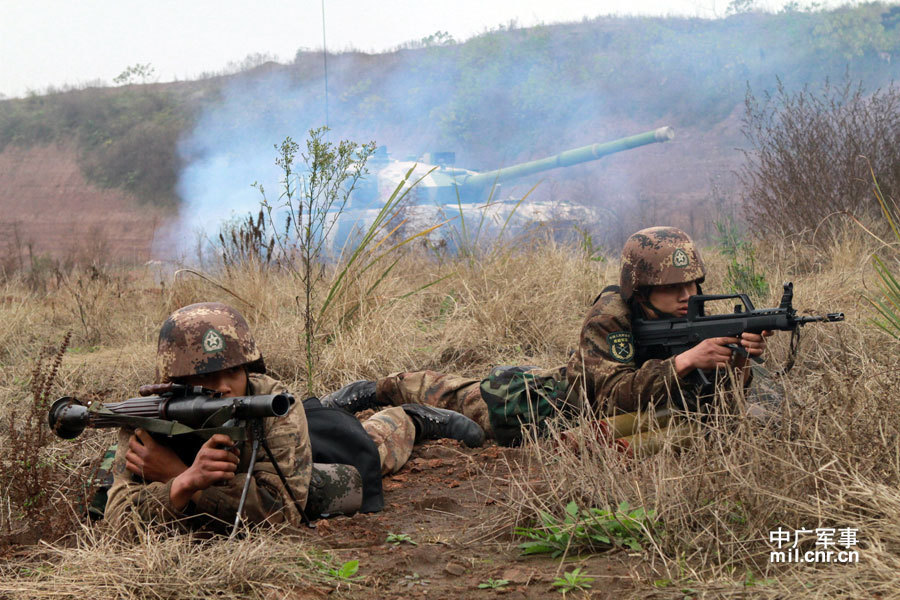
The People’s Liberation Army (PLA) Hong Kong Garrison – one of
China’s highest-profile military units – is a 6,000-strong force with some of
the PLA’s newest equipment. But it’s not armed to repel an invasion – its
purpose is to put down an uprising in Hong Kong itself. The garrison’s ground
force is largely light infantry with helicopters and wheeled personnel carriers
– none of which seem to have the anti-tank weapons that would be necessary in a
war – and it includes a naval unit with landing ships. The landing ships and
helicopters may be intended to make it possible to move troops across Victoria
Harbor (the channel between Hong Kong Island and the mainland) if the tunnels
that run underneath it are blocked.
The idea that they’re intended to suppress an uprising isn’t
speculation on my part. In 2012, units from the Hong Kong Garrison practiced operation
against enemies imagined to be Cantonese-speaking in a simulated urban area (most
of Hong Kong’s population speaks Cantonese, rather than Mandarin). They’ve also
conducted armed naval exercises in Victoria Harbor – as opposed to the naval
approaches to the city. It’s unambiguously clear where they’re expecting
trouble to come from: the city itself. Because of this, the Hong Kong public
doesn’t trust the garrison. Public sightings of PLA vehicles are frequently interpreted
as attempts at intimidation.
The garrison has also had a recent change of leadership, suggesting
that Beijing has asserted control in the face of possible widespread insubordination.
If Beijing orders the garrison to put down the protests with force, they will
probably follow their orders.
The Risks
No one wants another Tiananmen. A violent crackdown would
seriously damage the Chinese government’s reputation both internally and
internationally. Crushing hope for reform with bullets would also be guaranteed
to worsen the unrest in Xinjiang, threatening China’s unity.
But the list of possible peaceful outcomes is getting
shorter and shorter. The protesters aren’t going home – if anything, it seems
that their numbers are growing. What was once a student protest is increasingly
a representative cross-section of Hong Kong society. On the other side, Beijing
can’t back down without legitimizing public involvement in politics – which it
considers intolerable. With every day the protests continue, a violent
crackdown becomes more likely.
A Note on Taiwan
It’s hard to predict what the exact consequences of such a
crackdown would be. The “Umbrella Revolution” has had sympathy demonstrations
in Taipei, the capital of Taiwan. A bloody crackdown risks pushing Taiwan closer
to declaring independence – the one act sure to cause a Chinese invasion, which
would likely lead to thousands of deaths. Like Hongkongers, the Taiwanese have
increasingly affirmed an independent identity – but only a small minority of
the Taiwanese population are in favor of formal independence at this point.
Most support the status quo – de facto, but undeclared, independence. This does
makes an invasion-triggering declaration unlikely – but violence in Hong Kong
could still increase the pressure in that direction.